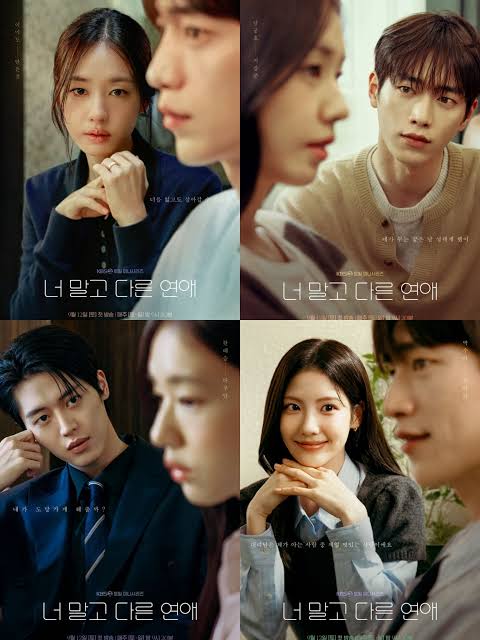
Written by Song Hye-jin and Directed by Jo Young-min
Production company Kakao Entertainment
Rating: ★★★★★
Can love and resentment exist within the same relationship without canceling each other out?
You and Everything Else does not try to answer that question with certainty. Instead, it quietly lingers within the discomfort of it. The series understands something deeply human about emotional intimacy, especially the kind that develops over years and slowly becomes entangled with memory, identity, admiration, guilt, dependency, and grief.
What moved me most is that the drama refuses to simplify friendship into something easily categorized as healthy or toxic, good or bad. Human relationships are rarely that clean. Sometimes the people who hurt us most are also the ones who once understood us best. Sometimes affection and resentment grow from the same emotional root. The series feels profoundly aware of that contradiction.
There is something particularly honest about the way it portrays female friendship. Not idealized. Not romanticized. Just emotionally true. The connection at the center of the story carries the same weight, intensity, and emotional exposure we often associate with romantic relationships. There is longing within it. There is comparison. There is emotional dependency. There is also tenderness that survives even after disappointment begins reshaping everything.
I think many people will recognize fragments of themselves here.
Not necessarily in the exact circumstances, but in the emotional texture of it. Most of us carry at least one relationship that quietly follows us through different versions of our lives. Someone who becomes so intertwined with our memories that separating the person from our own emotional history feels almost impossible.
The drama also approaches jealousy with unusual compassion. It does not excuse cruelty, but it tries to understand where emotional distortion comes from. Loneliness changes people. Emotional neglect changes people. Unresolved wounds can slowly transform admiration into comparison, and comparison into quiet resentment. The series never treats emotional pain as spectacle. It observes it with patience.
What makes the story especially powerful is its understanding of time.
Childhood does not disappear simply because adulthood arrives. Small moments continue echoing within us for years without us fully realizing it. A sentence, an absence, a feeling of rejection, the fear of not being enough. These experiences quietly shape the architecture of how we love and how we protect ourselves from being hurt again.
The narrative moves through different stages of life with remarkable emotional sensitivity, almost like memory itself. Not linear. Not perfectly reliable. Just deeply felt.
There is also something painfully truthful about the way the series explores emotional cycles. Some relationships do not break cleanly. People separate, reconnect, wound each other again, then still reach for comfort from the same person who caused the pain. It can be unhealthy, but it also feels deeply human. Emotional attachment is not always rational. Sometimes people remain connected because they became part of each other’s emotional language long ago.
What I appreciated most is that the drama does not force forgiveness into something pure or noble. Forgiveness here feels uncertain, unfinished, complicated. The story seems less interested in moral resolution and more interested in emotional truth. Perhaps forgiving someone does not always mean excusing them. Perhaps sometimes it simply means accepting that certain people permanently shaped who we became.
The series also quietly critiques the culture of comparison that so many people live within. Success, beauty, emotional strength, recognition, love. The constant measuring of one life against another slowly erodes intimacy until connection itself becomes fragile. It becomes difficult to truly see someone clearly once comparison has already entered the room.
Yet beneath all the sadness, the drama still leaves space for vulnerability.
One of its most meaningful ideas is that isolation deepens suffering. Some people become so accustomed to surviving alone that kindness itself begins to feel threatening. Care can feel like pity. Support can feel humiliating. The series understands how difficult it can be for wounded people to finally admit they need others.
And maybe that is what stayed with me most after finishing it.
Not the conflict itself, but the quiet recognition that healing often begins at the exact moment someone finally allows themselves to be seen honestly.
You and Everything Else is emotionally difficult at times, but never emotionally dishonest. It feels less like a conventional drama and more like an intimate reflection on memory, friendship, identity, and the invisible emotional marks people leave on each other over the course of a lifetime.
Image courtesy of Netflix